

Hydrocarbon Fuels Engines in the 20th Century
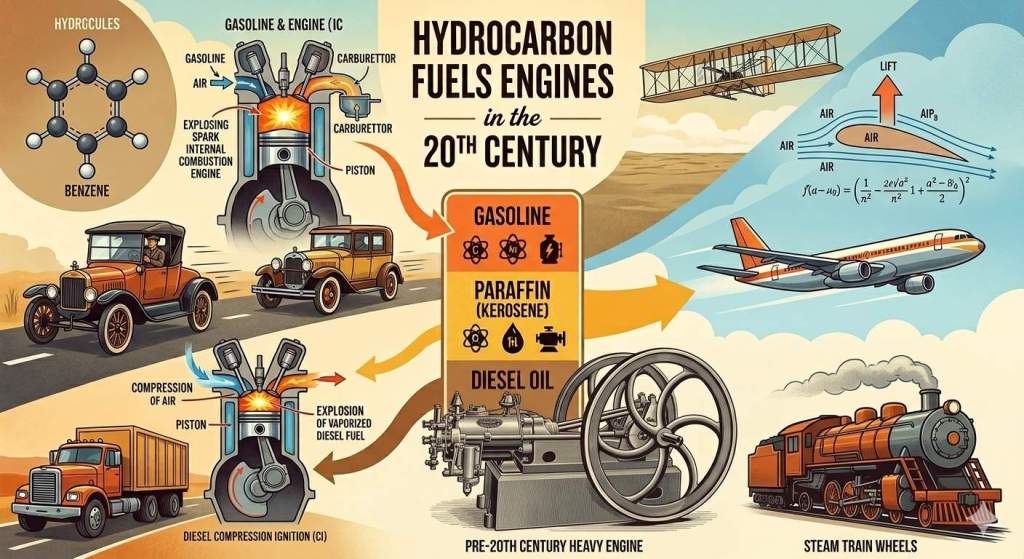
Transport in the twentieth century was revolutionised by the invention of engines running on hydrocarbon fuels – gasoline, diesel oil, and paraffin. The molecules in a pure hydrocarbon consist exclusively of hydrogen and carbon atoms; of this benzene is the most fundamental. Fuels come from naturally occurring petrochemicals, consisting mainly of hydrocarbons, but with other chemical components, such as nitrogen, oxygen, and sulphur.
Refining produces first gasoline (with five to eight carbon atoms), then paraffin (with eleven or twelve), and finally diesel oil (with thirteen to fifteen). Each of these three fuels has its own characteristic engine, the distinctive features being determined by the form of combustion. Gasoline, vaporised by means of a carburettor mixing it with air, is ignited by an electric spark and explodes to drive a piston in a cylinder: this explains the term ‘internal combustion’ (IC).
Paraffin burns under pressure in a process of continuous combustion, producing a jet of hot gases that can be used directly as a means of propulsion. Diesel fuel, in the form of vapour, explodes as a result of being compressed in a cylinder, hence the common designation ‘compression ignition’ (CI): as a result of the gas laws, the temperature then increases to the flashpoint at which combustion occurs.
The IC engine was largely the invention of Karl Benz (1844-1929), whose first car appeared in 1885: the engine is still standard for automobiles, but the CI engine of Rudolf Diesel (1858-1913) is more suited for heavy vehicles, locomotives, and boats, where it is more than twice as efficient as comparable steam engines. The much lighter IC engine, on the other hand, was much more suitable for science, technology, and communication aircraft, and was standard from the Wright brothers’ first airplane until the invention of the jet engine driven by paraffin. Today’s light aircraft still use the IC engine with gasoline as fuel. The advantage in every case was the extreme light weight of the engine and the fuel it consumed.
The need for a tender for coal and water was completely bypassed. A steam-driven aircraft would never have left the ground. Powered flight. Apart from the essential IC engine, Orville (1871-1948) and Wilbur Wright (1867-1912) designed their first airplane according to aerodynamic principles of wing theory developed in the second half of the nineteenth century, mainly in Germany. The main problem, the shape of the cross-section of the wing, can be solved with the use of the mathematical theory of complex variables.
The basic principle, established by the Swiss mathematician Daniel Bernoulli (1700-82), is that air must flow more rapidly over the top than under the bottom of the wing, so that the pressure of the air above is less than that below the aircraft, thereby creating ‘lift’. For this to happen, the aircraft must be moving forward: this, originally, was the function of the propeller, first developed in 1842 by Isambard Kingdom Brunel (1806-59) for his ship, the Great Britain – the fluid dynamic principles being the same. (The greatest engineering problem facing the Wright brothers was finding the right metal for a propeller shaft that would withstand the stress caused by torque.)
A jet aircraft substitutes the thrust of hot gases for that of the propeller. The distinction is critical for performance. The propeller is most efficient in the relatively dense atmosphere of lower altitudes, but this at the same time, offers the most resistance to the forward movement of the airplane. The jet engine is most efficient at high altitudes, where this resistance is at a minimum; the only limit to height is the need for some atmosphere to provide lift. Even so, the U2 reconnaissance airplane can fly to heights of up to nearly 30,000 metres. The power of a jet engine is essentially that of a rocket, so the technology goes back a long way in history. In China, rocket-powered projectiles were used in the Sung-Chin wars almost a thousand years ago.
The rocket was superior to any comparable war engine in that it continued to deliver its power after launching. The basic science consisted of finding a fuel (gunpowder in Sung China) that would burn at an optimal rate. This is the essential chemical problem in all ballistics. Cordite, first developed in the nineteenth century as a propellant for shells, became standard for this purpose simply because of its unprecedentedly high performance.

Read More: Exploring the Natural Wonders of Crystal Geyser, Utah