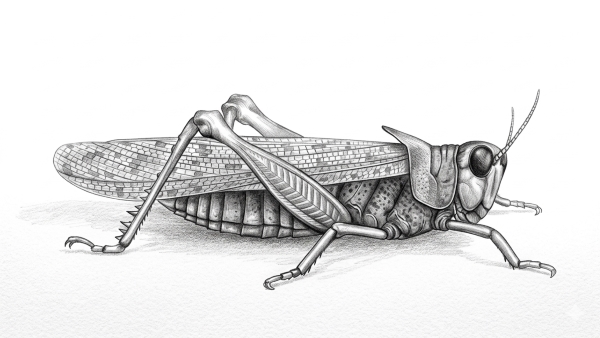
If you insect lover, then you must be curious about how 12 trillion Rocky Mountain Locusts (Melanoplus spretus) vanished from Earth. This is a mind-blowing history of massive swarms and the sudden extinction of this legendary insect.
The Swarming Phenomenon
In the late 19th century, much of the United States was a frontier where pioneers sought to achieve their American dream, and many of them traveled to the vast prairies of this continent. The term prairie evokes images of beautiful, undulating plains reaching as far as the eye can see, yet this portrait is not entirely accurate. In the winter, these plains get severely cold, and in the summer, they are scorching. Add to this an almost constant wind, and what you get is a harsh environment.
As if these difficult conditions weren’t enough for the residents, they were also confronted with an insect that gathered in swarms of a monstrous nature. The Rocky Mountain locust was small by normal locust standards, with an adult body length of 20 to 35 mm, long wings that extended past the end of the abdomen, and the enlarged back legs common to most grasshoppers. What this insect lacked in individual size it more than compensated for in the size of its groups.
Locusts, for much of the time, live their lives in the same way as most other grasshoppers—going about their tasks without being much of a bother to anyone—but occasionally, their populations may become very congested, and this triggers a dramatic transformation. The locusts change color, their wings grow, and they start to cluster in swarms.
The Great Swarm of 1874
The swarms formed by the Rocky Mountain locust were extraordinary and probably represent some of the biggest masses of any land animal that has ever existed. A swarm observed in Nebraska during the summer of 1874 was of immense proportions. Dr. A. L. Child of the U.S. Signal Corps was tasked with evaluating just how big this swarm was, and to get an idea, he measured the speed of the locusts as they were flying past and then telegraphed surrounding towns to get an idea of its extent.
The swarm was estimated to be about 2,900 km long and 180 km wide. Observers in the Nebraskan towns over which this swarm passed reported that the gigantic cloud of insects blocked the sun and took five days to pass overhead. Estimates suggest there must have been around 12 trillion insects in this multitude, weighing somewhere in the region of 27 million tonnes.
The Mystery of Extinction
Around 30 years after these colossal swarms left a trail of ruin, the Rocky Mountain locust mysteriously disappeared. The likely explanation for the disappearance is that outside of its swarming periods, the locust withdrew to the sheltered valleys of Wyoming and Montana, where the females laid their eggs in the fertile soil.
These very same valleys attracted the attention of settlers who, with their horses and plows, turned the soil over and grazed their livestock. These actions destroyed the eggs and the developing young of the insect. Around three decades after its swarms obscured the sun, the Rocky Mountain locust was gone forever.
Key Facts
Survival Mechanism: Swarming is thought to be a survival mechanism triggered when environmental conditions concentrate nymphs into shrinking areas. When they get “too cozy,” they switch from intolerance to attraction, forming bands and flying off in search of food.
Egg Sacs: Females used tough valves at the end of their abdomens to excavate tunnels. Eggs were cocooned in a hardened foam egg sac with the appearance of a “stale marshmallow.”
Grasshopper Glaciers: High winds drove swarms into the mountains where they perished on glaciers. Today, as these glaciers thaw, they reveal mummified remains.
Rarity in Collections: Surprisingly few specimens exist in collections today because entomologists at the time could not conceive that such a numerous animal could ever go extinct.
ROCKY MOUNTAIN LOCUST
Scientific name: Melanoplus spretus
Scientific classification
Phylum: Arthropoda
Class: Insecta
Order: Orthoptera
Family: Acrididae
When did it become extinct? The final observation of this insect was in 1902.
Where did it live? The original range of this insect was the eastern slopes of the Rocky Mountains, stretching from the southern forests of British Columbia through Montana, Wyoming, Idaho, and the western parts of the Dakotas. In certain years, the species was capable of widening its range to occupy one-third of Manitoba, the Dakotas, Minnesota, Kansas, Oklahoma, Missouri, the western half of Nebraska, and the northeastern part of Colorado.
Read More: The Dangers of a Rat Infestation and Why You Need Professional Extermination