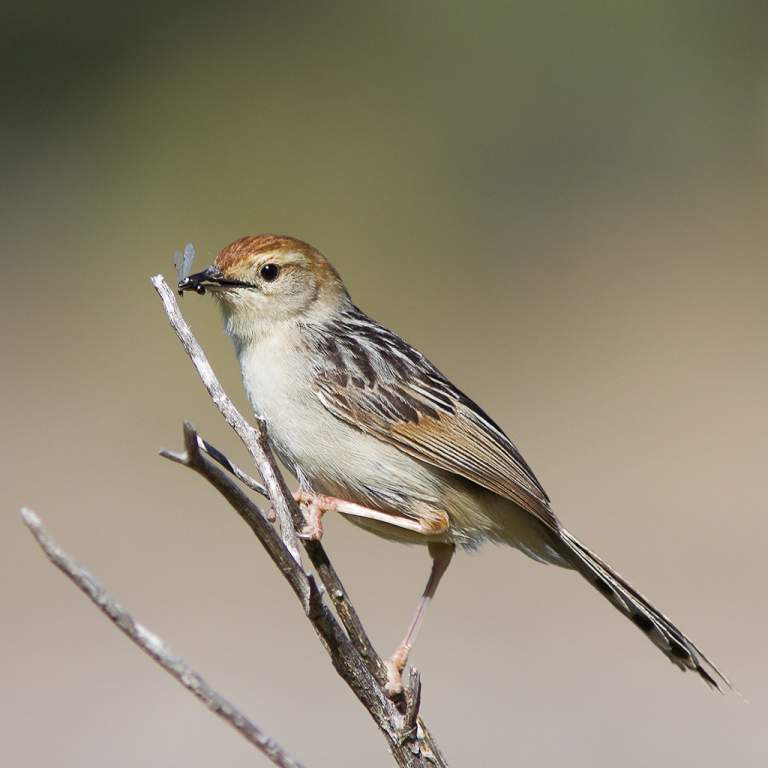
The Tinkling Cisticola (Cisticola rufilata) is a woodland bird found across south-central Africa, ranging from the northern parts of southern Africa northwards to Angola and eastwards to western Malawi. Botswana’s Kalahari region is the centre of its abundance, although the species is more sparsely distributed across Zimbabwe and northern Namibia. In South Africa, it occurs in scattered locations across the central and northern regions, including northern and western Transvaal and the northern Cape Province. Birds inhabiting the Kalahari sands of Namibia, Botswana and South Africa belong to the nominate race, while those found farther northeast on the Zimbabwean plateau are assigned to the race C. r. vicinior (Clancey 1980b; Irwin 1981).
At the edge of its range, in favourable habitat at Nylsvlei (2428DA), the species has been recorded at a density of one pair per 12 hectares (Tarboton et al. 1987b).
In the heart of its distribution in Botswana, surveys recorded 81 birds along transects covering 140 hectares of Central Kalahari habitat, equivalent to approximately one bird per 1.7 hectares. However, no individuals were encountered during surveys of 70 hectares in the Northern Kalahari (M. Herremans, unpublished data).
The Tinkling Cisticola is most likely to be confused with the Rattling Cisticola (C. chiniana). However, its distinctive call, orange-rufous tail and preference for different habitats help distinguish it from its close counterpart. Lynes (1930) described the species as one of the most secretive cisticolas, suggesting that it may have been under-recorded during the atlas surveys. It is generally encountered alone, in pairs or in family groups.
Habitat: The species favours scrub in open woodland, particularly dry, deciduous woodland growing on sandy soils. In northern Transvaal, its habitat has been described as broad-leaved deciduous savanna or scrub, interspersed with open patches of rank grass and scattered low trees such as Terminalia sericea and Burkea africana (Tarboton et al. 1987b).
In Botswana, the Tinkling Cisticola inhabits stunted bushes and secondary growth in grassland, as well as the edges of pans surrounded by semi-desert bush and scrub savanna. It also occurs along woodland margins and in tree savanna on sandy ground in northern Botswana, including scrubby Mopane woodland and disturbed areas where secondary vegetation has developed (Penry 1994).
In the Okavango region, the species occupies dry, sandy floodplains where scrub is regenerating. In Zimbabwe, it is found in savanna scrub, areas of Kalahari sand and along the margins of Baikiaea and Brachystegia woodland (Irwin 1981).
Although the overall reporting rate was considerably higher in the Northern Kalahari than in the Central Kalahari, this difference reflects the species’ absence from a substantial portion of the Northern Kalahari biome in the northern Cape Province. The Tinkling Cisticola is almost certainly most abundant in Botswana’s Central Kalahari.
Movements: The Tinkling Cisticola is a resident species. Reporting rates show a pronounced peak during late summer, from December to March, followed by very low figures in winter. This seasonal pattern is also evident in regions where the bird is uncommon. Rather than indicating seasonal movement, the trend reflects its secretive behaviour: individuals are seldom recorded when they are not calling.
Breeding: Egg-laying has been documented throughout the summer months, from October to March, with the highest activity occurring between December and February (Irwin 1981; Skinner 1995a; Brown & Clinning, in press).
Interspecific relationships: In southern Africa, the Tinkling Cisticola is grouped in a superspecies with the Greybacked Cisticola (C. subruficapilla) and the Wailing Cisticola (C. lais) (Hall & Moreau 1970). Neither of these species overlaps geographically with the Tinkling Cisticola.
The Tinkling Cisticola resembles the Rattling Cisticola in both size and shape, and the two species also occupy woodland habitats. However, the Rattling Cisticola generally favours moister woodland, particularly dense Acacia savanna. The complementary nature of their distributions is especially apparent in eastern Botswana, along the boundary between the Kalahari sandveld and the eastern hardveld. Their ranges overlap more extensively in northern Botswana, where the two species appear to fulfil similar ecological roles in different woodland types.
The Tinkling Cisticola also shares much of its range with the Blackchested Prinia (Prinia flavicans), although the extent to which the two species compete remains unknown. The species serves as a host for the brood-parasitic Sharpbilled Honeyguide (Prodotiscus regulus) (Tarboton et al. 1987b). Historical distribution and conservation: There is no known evidence that the Tinkling Cisticola’s historical range differed from its present distribution. The species is widespread in dry woodland habitats that are unsuitable for intensive agriculture, although bush-clearing and overgrazing could pose risks to local populations. At present, the Tinkling Cisticola is not considered threatened. Read More: Prothonotary Warbler