Extinction Insight: The Great American Interchange
After their discovery by Europeans in 1492, North America and South America became collectively known as the Americas, or the New World—two enormous landmasses that had existed as close geographic neighbors for countless ages. Despite their proximity, however, the geological histories of North and South America differ dramatically. For vast periods of Earth’s history, no physical connection existed between them at all.
Long ago, all of Earth’s landmasses were joined together in a supercontinent called Pangaea. Over millions of years, this immense landmass gradually fragmented. The continents that now make up the modern Southern Hemisphere formed the southern supercontinent known as Gondwanaland, while those of the Northern Hemisphere became part of Laurasia. Through the relentless movement of plate tectonics, these supercontinents slowly drifted apart and evolved into the continents we recognize today. Carried atop the viscous rock of Earth’s mantle, they eventually settled into positions similar to their current locations.
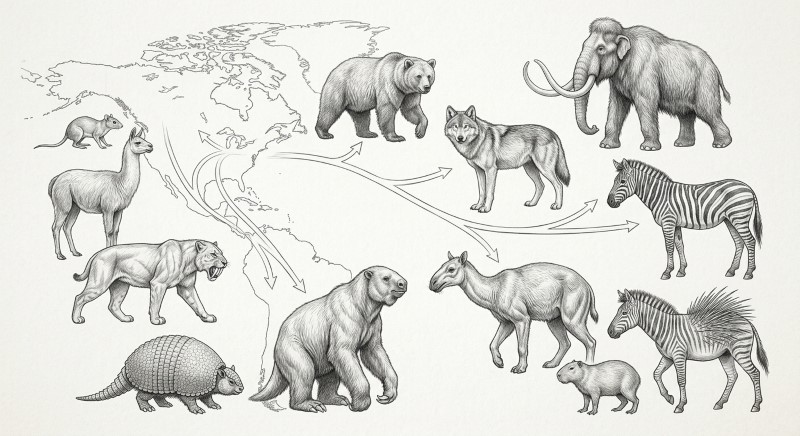
Although South America faced North America across the equator, no direct land connection linked the two continents. The emergence of a land bridge between them would later allow animals to migrate freely between North and South America in an event now known as the Great American Interchange. Several groups of North American mammals expanded into South America, while comparatively few South American mammals successfully moved northward and flourished.
North America maintained intermittent connections with other landmasses through temporary land bridges that occasionally formed between its northwestern edge and eastern Asia. South America, by contrast, remained isolated for extraordinarily long stretches of time.
Because of this isolation, the wildlife of South America evolved independently, producing a remarkable and highly distinctive fauna. Its mammals were especially fascinating, with many animal groups found nowhere else on Earth. Although the continent remained separated from the rest of the world, some species still managed to arrive there. Scientists believe that rodents and monkeys reached South America between 25 and 31 million years ago by accidentally rafting across the then-narrow Atlantic Ocean from Africa on floating mats of vegetation.
Much later, around 7 million years ago, certain members of the mammalian group that includes raccoons and coatis migrated from North America into South America by island hopping. These stepping-stone islands represented the highest points of what would eventually become modern Central America, which was gradually rising above sea level due to tectonic activity beneath the ocean floor.
South America’s long isolation and unique wildlife changed dramatically approximately 3 million years ago, when geological upheaval forced the Isthmus of Panama completely out of the ocean, creating a direct land connection between the two continents. This marked the beginning of the Great American Interchange. Over the following thousands of years, animals and plants traveled across this newly formed corridor of dry land, moving freely between North and South America.
Many mammals now closely associated with South America actually originated in North America. Llamas and tapirs, for instance, trace their ancestry to northern migrants. Other animals that journeyed south included horses, cats such as the cougar and jaguar, dogs, bears, and numerous rodent species.
Some South American mammals also crossed into North America, although many of these species eventually became extinct. Among them were the massive glyptodonts and giant ground sloths. Today, the only surviving North American mammals with South American origins are the Virginia opossum, the nine-banded armadillo, and the North American porcupine.
For reasons scientists still do not fully understand, South American species generally struggled to establish themselves in the north, while North American animals adapted successfully and prospered in South America. The few ancient South American species that left a lasting mark in North America were typically those equipped with some form of protection. Glyptodonts, much like modern armadillos, possessed thick armored carapaces, while giant ground sloths relied on their enormous size, powerful claws, and durable skin for defense.
Apart from mammals, another notable South American group—the terror birds—also managed to survive in North America for a period of time. Some researchers believe these formidable predators may have migrated by island hopping before a permanent land bridge fully connected the continents.
The animals that moved southward from North America flourished in their new environments, and many still inhabit South America today, despite the continent being heavily transformed by human activity. All South American cats, bears, and dogs originated in North America, yet they adapted exceptionally well to the continent’s diverse habitats. Some may even have contributed to the extinction of several native South American mammals.
The giant native animals once unique to South America have all vanished. Today, only fossilized bones and fragments of preserved hide remain as evidence of their existence. Yet many smaller relatives of these extinct giants survive.
More than 80 species of marsupials still inhabit South America, though most are tree-dwelling creatures that feed primarily on insects and fruit. The descendants of the enormous ground sloths continue to live in the forests as the five modern species of sloth, famous for their slow movements and relaxed behavior.
Anteaters, unlike any other mammals, are not exclusive to South America, but the continent is home to their largest representative—the giant anteater. Armadillos also continue to survive as around 20 living species. Although they appear superficially similar to the ancient glyptodonts, they are only distant relatives of those heavily armored giants of the Pleistocene, some of which grew to the size of a small automobile.
Hundreds of thousands of years after the Great American Interchange reached its height, humans entered the Americas by crossing the Bering land bridge. However, growing evidence suggests that early seafarers may have arrived long before people migrated overland. Regardless of the exact route, humans eventually spread southward into South America. Some early journeys may have been made by boat, but the same land corridor that animals have used for millennia almost certainly also served as a pathway for human migration. Read More: Pets, Messengers, and Symbols of Peace: Pigeons and Doves