In this article, we will learn about why cats the true carnivores. Cats are carnivores, not by choice, but by necessity. Many of their relatives in the animal kingdom, though referred to as Carnivora, are actually omnivores—including domestic dogs, foxes, and bears—and some, like pandas, have reverted to being vegetarian. The whole cat family, from the lion down to the tiny black-footed cat from southern Africa, has the same nutritional needs.
At some point, many millions of years ago, the ancestral cat became such a specialized meat-eater that it lost the ability to live on plants: it became a “hypercarnivore.” Once lost, such capabilities rarely re-evolve. Domestic cats might have been more successful if they could have gotten by, as dogs can, living on scraps, but they are stuck firmly in the nutritional dead end their ancestors bequeathed to them. Cats require far more protein in their diet than dogs or humans do, because they get most of their energy not from carbohydrates but from protein. Other animals, faced with a shortage of protein in the diet, can channel all the protein they do get into maintaining and repairing their bodies, but cats cannot.
Cats also need particular types of protein, especially those that contain the amino acid taurine, a component that occurs naturally in humans but not in cats. Cats can digest and metabolize fats, some of which must come from animal sources, so that the cat can use them to make prostaglandins, a type of hormone essential for successful reproduction. Most other mammals can make prostaglandins from plant oils, but cats cannot. Female cats must get enough animal fat during the winter to be ready for their normal reproductive cycle, mating in late winter and giving birth in the spring. Cats’ vitamin requirements are also more stringent than ours.
They need vitamin A in their diet (if need be, we can make ours from plant sources), sunshine doesn’t stimulate their skin to make vitamin D as ours does, and they need lots of the B vitamins niacin and thiamine.19 None of this is a problem if the cat can get plenty of meat, although raw fish, which contains an enzyme that destroys thiamine, can cause a deficiency if eaten in excess. It is slightly possible to construct a vegetarian diet for cats, but only if every single one of the cat’s nutritional peculiarities is carefully compensated for. Their taste buds also differ substantially from our own, having evolved to focus better on an all-meat diet.
They cannot taste sugars; instead, they are much more sensitive than we are to how “sweet” some kinds of flesh are, compared to others, which they find bitter. Cats do have two notable nutritional advantages over humans. First, their kidneys are very efficient, as expected for an animal whose ancestors lived on the edge of deserts, and many cats drink little water, getting all the moisture they need from the meat they eat. Second, cats do not require vitamin C. Taken together, these make cats well suited to shipboard life: they don’t compete with sailors for precious drinking water, getting all they need from the mice they catch, and they are not afflicted by scurvy, a common disease among mariners to the middle of the eighteenth century, when it was found it could be prevented by eating citrus fruits. meat, which we can. (Though classified as carnivores, even dogs are actually omnivores; they may prefer meat, but cereal-based foods can, if necessary, give them all the nutrition they need.)
For most of their coexistence with humankind, cats were valued primarily for their skill as hunters. Since mice contain all the nourish – ment a cat needs, a successful hunter automatically ate a balanced diet; starvation was always possible for the less adept or the unlucky, but diseases due to specific nutritional deficiencies were unlikely. However, even historically, few domestic cats would have lived by hunting alone; most were provided with at least some food by their owners, supplementing their diet by scavenging. So long as some of their diet came from fresh meat, usually in the form of prey they had killed themselves, scavenging would not have tipped them into nutritional imbalance; still, giving up hunting entirely would have been risky. Cats do not scavenge accidentally; they have some ability to make informed choices.
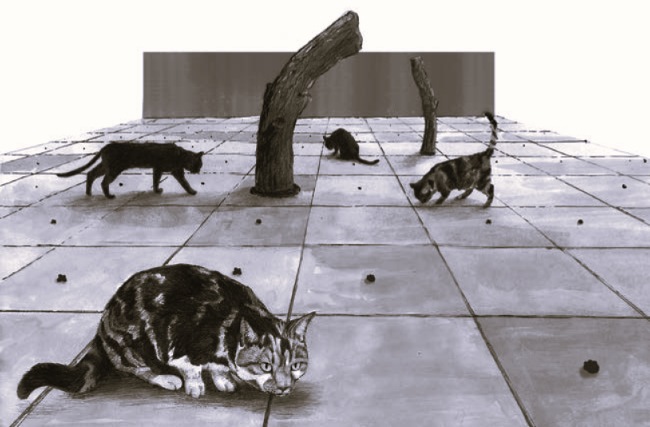
They subsequently avoid foods that make them feel seriously and instantly ill. When eating food that they have not killed for themselves, they also deliberately seek out a varied diet, thereby avoiding a buildup of anything that might make them sick long-term, but might slip beneath the radar of immediate malaise. To demonstrate this behavior, I laid out individual pieces of dry cat food on a grid on the ground, some of one brand, some of another, and then allowed rescued strays to forage over them, one at a time. In this way, I could record in precisely what order each cat picked up and ate the pieces of the two foods. When there were equal numbers of each type of food, the cats roamed across the grid, eating both foods but more of whichever food they liked better.
However, when one of the two foods made up 90 percent of the total, every cat, whatever its preference, stopped grazing indiscriminately within a couple of minutes and started actively seeking out the rarer food. Thus, these cats demonstrated a primitive “nutritional wisdom,” as if they assumed that eating a variety of food was more likely to produce a balanced diet than simply eating the food that was easiest to find (even though both the foods offered were nutritionally complete). When I gave similar choices to pet cats that had always had a balanced diet, few responded this way; most continued to eat whichever of the two foods they liked better from the outset, or it was just easy to find.
Thus, though all cats perhaps have the capacity to deliberately vary their diets, it seems that this ability must be “awakened” by some experience of having to scavenge for a living, as most of the stray cats in our original experiment must have done before they were rescued.21 Most other animals have more varied diets than cats’. Rats, the best-studied example, are omnivores with extremely wide tastes that suit them perfectly for a scavenging lifestyle. They employ several strategies that enable them to pick the right foods from the wide but unpredictable choices available to them.
New foods are only nibbled at until the rat is sure that they’re not poisonous. As soon as each food starts to be digested, the rat’s gut sends information to its brain about its energy, protein, and fat content, enabling the rat to switch to another food with a different nutritional content if necessary. Cats are much less sophisticated in this regard, having traveled a different evolutionary path based mainly on eating fresh prey, which is by definition nutritionally balanced. Given their limited ability to subsist by scavenging alone, cats were locked into the hunting lifestyle until as recently as the 1980s.
Until science revealed all of their nutritional peculiarities, it would have been a matter of luck whether a cat that wasn’t able to hunt obtained a nutritionally balanced diet, unless its owner was both willing and able to give it fresh meat and fish every day. Although commercial cat foods have been available for over a century, there was initially little understanding that cats had very different requirements from dogs, and much of this food must have been nutritionally unbalanced.
Commercial cat food that is guaranteed to be nutritionally complete has been widely available for only thirty-five years or so—only 1 percent of the total time since domestication began. In evolutionary terms, this is just the blink of an eye, and we have yet to see the full effects of this improvement in nutrition on cats’ lifestyles. Just a few dozen generations ago, the cat that was a skillful and successful hunter was also the cat that stood the best chance of breeding successfully. Those cats that depended entirely on man for their food would usually obtain enough calories to keep them going day-to-day, but many would not have bred successfully, because many of the cat’s unusual nutrient requirements are essential for reproduction. Nowadays, any cat owner can go to the supermarket and buy food that keeps their cat in optimum condition for breeding.
That is, of course, if the cat has not been neutered—another development that has yet to show its full effect on the cat’s nature. Today’s cat is thereby a product of historical turmoil and misconception. What would today’s cats be like if they had not gone through centuries of persecution? It is possible that the effects may not have been particularly long-lasting. After all, since serious attempts were made to exterminate black cats in continental Europe because of their supposed association with witchcraft, they should still be uncommon there today—and they’re not. Although undoubtedly many individual cats did suffer horribly, little lasting damage seems to have been done to the species as a whole.
This is probably because, for most of the time and in most places, particularly in the countryside, cat-keeping was both enjoyable and practically beneficial, even if occasionally interrupted by an outburst of religious persecution. Changes have taken place—cats today are significantly smaller and more varied in color than when they left Egypt—but these changes appear to have been mainly local rather than global. Thus, following the origin of their partnership in ancient Egypt, cats and humans continued to live alongside one another for a further 2,000 years without the cat ever becoming fully domesticated.
Then, due to the nutritional discoveries of the 1970s, all cats, and not just the pets of the well-off, were relieved of the necessity to hunt for a living. However, their predatory past, so essential to their survival until recently, cannot be obliterated overnight. One of the most significant challenges facing today’s cat enthusiasts is how to allow their cats to express their hunting instincts without causing wildlife damage, which evokes so much criticism from the anti-cat lobby.