Habitat: Black-billed cuckoo (Coccyzus erythrophthalmus) is vagrant (Western Europe, Azores). In natural range, forest edges, woodland, and riverside thickets. The black-billed cuckoo is a fairly common bird. It may breed irregularly to the west of the mapped range. Migrates southeast to winter in Southeast Asia and Australasia.) Forest, including both dense areas and edges and clearings, is woodland.
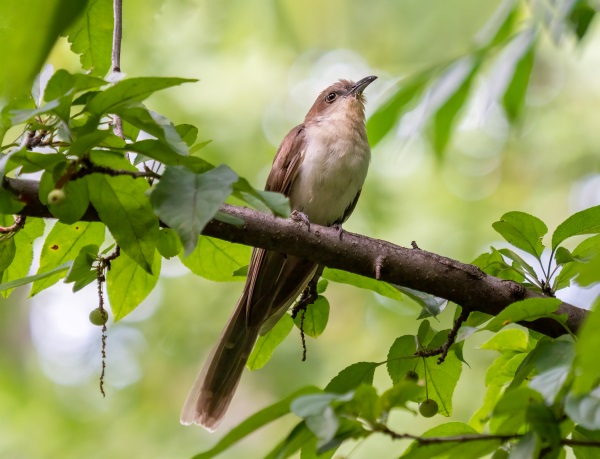
Identification: Black-billed Cuckoo is a slender transatlantic vagrant known for its secretive behavior. This fairly small, slim cuckoo is likely to be confused only with a vagrant Yellow-billed. Both are rather uniform, dull brownish above and dull whitish below, giving a vaguely dove-like impression. Both tend to skulk in vegetation, flying between cover with shallow wingbeats and frequent glides.
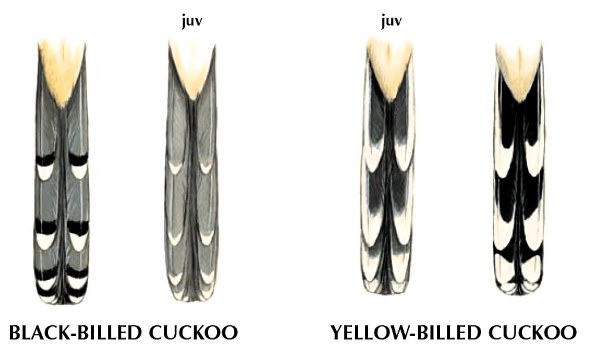
Black-billed cuckoo has a bill largely black, with a pale bluish-grey base to the lower mandible, while Yellow-billed cuckoo has most of the lower mandible and the cutting edge of the upper mandible yellow; the bill of Black-billed cuckoo is also finer and slightly less decurved. Black-billed has a grey underside to the tail with narrow white tips (bordered subterminally by blackish) to median and outer feathers (pale tips are particularly indistinct when worn); Yellow-billed has a black underside to the tail with extensive white tips to median and outer feathers.
Differences can be hard to see unless the tail is spread or the underside is clearly visible. In juveniles and first autumn birds, tail pattern differences are less marked. Black-billed has the underside of the tail grey with narrow and rather indistinct white tips to the median and outer feathers (subterminal blackish bars are lacking); Yellow-billed has the underside of the tail dark grey, rather than black, and broad white tips to the median and outer feathers are less clearly defined (but still much larger and more prominent than in Black-billed).
Eye-ring of adult Black-billed is red (yellow in adult and 1st-winter Yellow-billed, grey in juvenile Yellow-billed), but note that juvenile and 1st-winter have a yellow eye-ring. Flight feathers of adult Black-billed uniform brown, but distinctly tinged rufous in Yellow-billed in all plumages. Note, however, that juvenile and first-autumn Black-billed has rufous tinge to flight feathers, although the contrast is not so obvious as in Yellow-billed. Upperparts of Black-billed cuckoo tend to be browner, less grey-tinged, and throat and breast tend to be less white than in Yellow-billed, but these differences are subtle and hard to see.
Sex: Black-billed cuckoo juvenile resembles adult, but has warmer, rufous-brown tinge above and inconspicuous pale feather fringes, rufous tinge to flight feathers, and narrower tail feathers that lack obvious dark subterminal bar and have more diffuse whitish tips; eye-ring yellow. Post juvenile moult starts early, so unlikely to be recorded fully in juvenile plumage in our region. The first winter, much as adult, but has a yellow eye-ring and retains juvenile flight feathers and tail until reaching winter quarters.
Nesting: Black-billed cuckoo builds its nest and raises its own young. It rarely lays eggs in the nest of other birds.
Vocalization: Black-billed cuckoo advertising call (unlikely to be heard in our region), a monotonously repeated, fast, rhythmic, hollow ‘cu-cu-cu’ or ‘cu-cu-cu-cu’.
Diet: Black-billed cuckoo mainly eats caterpillars and webworms.
Size: The black-billed cuckoo is 27–31 cm in length, and its wingspan is about 38–42 cm.