When did it become extinct? The gastric-brooding frog was last seen alive in 1981.
Where did it live? The gastric-brooding frog was known only from the Conondale and Blackall mountain ranges in southeast Queensland, Australia.
Another victim of the amphibian disaster was a remarkable little frog from Australia that was discovered only in 1973. Yet, by 1981, it had disappeared without a trace.
The gastric-brooding frog was a small species, with females reaching around 5 cm in length and males measuring approximately 4 cm. It inhabited forest streams and rocky pools, spending much of its time concealed beneath rocks on the beds of these waterways. When it emerged from its rocky shelters and ventured into the fast-flowing water, however, it proved to be a highly capable swimmer. Its strong hind limbs ended in feet that were almost entirely webbed, allowing it to drive itself efficiently through the water. The frog’s large, prominent eyes were positioned high on its head, enabling it to keep watch over activity in the air and on land while the rest of its body remained hidden beneath the surface. Although it was exceptionally well suited to life in water, the gastric-brooding frog would regularly leave the stream to search for food or locate another stretch of suitable water.
Its preferred prey consisted of small invertebrates, particularly insects. Unlike many other frogs, however, the gastric brooder did not possess a long, sticky tongue with which to snatch its prey. Instead, it waited until its food came within striking distance and then lunged forward with its mouth wide open. Once the prey was partly caught, the frog used its forelimbs to push the remainder of the victim into its mouth. Despite being an effective hunter, this frog was tiny and therefore made an appealing meal for a variety of predators. Herons and eels were among those that preyed upon this amphibian, but it possessed a useful means of defense if one of these animals managed to seize it: mucus. All amphibians have skin glands that produce mucus, helping to keep the skin moist and providing a degree of protection. The gastric brooder could produce an abundant supply of extremely slippery mucus, making it difficult for a predator to maintain a firm grip.
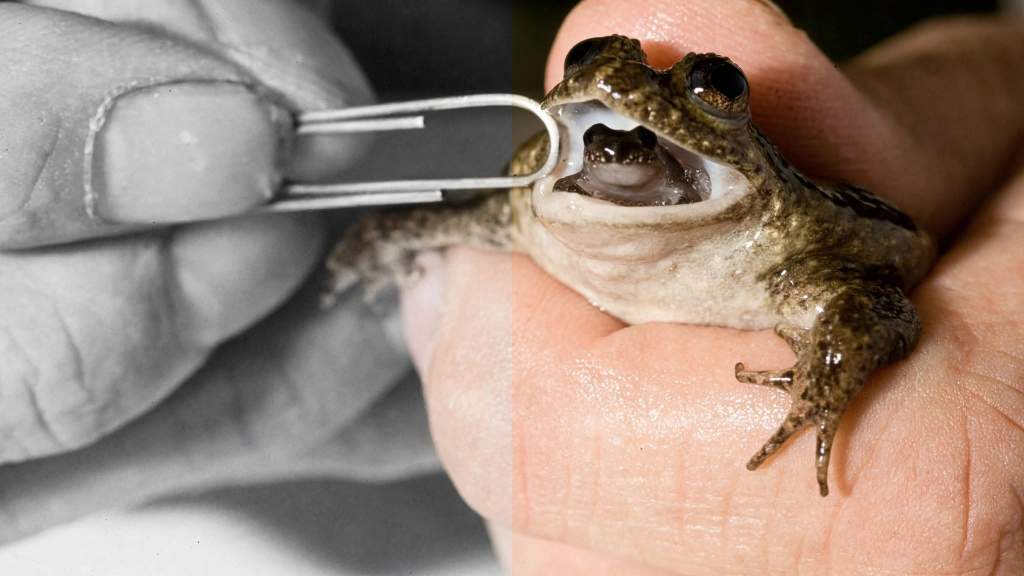
In most respects, the gastric-brooding frog resembled other frogs, but its method of reproduction made it truly extraordinary. Mating was never observed in this species, but it is known that the female laid between 26 and 40 eggs, which were subsequently fertilized by the male. This followed the normal amphibian pattern, since fertilization in these animals takes place externally. What happened after fertilization is not completely clear because the process was never actually witnessed. At some point, either while the offspring were still eggs or after they had hatched into tiny tadpoles, the female swallowed as many of her offspring as she could. To someone unfamiliar with the species, this might have appeared to be an act of maternal cannibalism, but it was actually a crucial part of the frog’s extraordinary reproductive strategy.
The eggs or tiny tadpoles passed down the mother’s throat and entered her stomach, where they continued to develop. In animals generally, the stomach is an organ devoted largely to digestion. Cells lining the stomach produce powerful acids that break food down into its component fats, proteins, and carbohydrates, allowing enzymes to continue the digestive process. Such a harsh, acidic environment would seem entirely unsuitable for developing offspring. Over millions of years, however, these frogs evolved a remarkable adaptation that transformed the stomach into a protected chamber for their developing young.
It appears that the eggs and tadpoles of this frog produced a chemical called a prostaglandin. This substance prevented the cells lining the stomach from releasing acid, while the stomach walls themselves became thinner. In effect, the young transformed their mother’s stomach into a warm and protected nursery. After spending six to seven weeks developing inside their mother’s alimentary canal, between 6 and 25 tiny but fully formed froglets emerged from her mouth and began life on their own in the outside world. Throughout this entire brooding period, the female’s stomach was effectively shut down, leaving her unable to eat. Once her young had finally departed, her priority was probably to find something to eat.
In fewer than 10 years after its discovery, the gastric-brooding frog had disappeared. Extensive searches of mountain streams during the early 1980s failed to produce a single specimen. When the species was first discovered in 1973, it was regarded as fairly common. By 1981, however, not one individual could be found. It was almost as if the species had simply been spirited away.
As with the golden toad of Costa Rica, the precise cause of the gastric-brooding frog’s disappearance remains unknown, although several explanations have been proposed, some more convincing than others. Pollution of mountain streams caused by logging companies and gold panners has been suggested as a possible reason for the species’ decline, but tests of the stream water failed to reveal any significant pollution. Habitat destruction has also been proposed, yet the areas inhabited by the frog were relatively well protected.
With pollution and habitat destruction largely discounted, attention turns to the possibility of disease. Chytrid fungus has been responsible for the deaths of amphibians in many parts of the world. The fungus attaches itself to an amphibian and becomes established within its skin. It forms cysts in the deeper layers of the skin and breaks down keratin, a protein found in the cuticle of many vertebrates, including adult frogs and toads. As infection progresses, the skin of an affected amphibian begins to deteriorate, and in severe cases the disease can penetrate deeper tissues. Digits and even entire limbs may be destroyed. Although this damage is not necessarily fatal by itself, the infection probably interferes with the skin’s ability to transport gases and prevent harmful microorganisms from entering the body. Eventually, the infected animal dies a slow and probably very painful death.
- The species discussed here is actually the southern gastric-brooding frog. In 1984, a closely related species, the northern gastric-brooding frog (Rheobatrachus vitellinus), was discovered living in the Clarke Mountains near Mackay in central coastal Queensland. A year later, this species also experienced a complete population crash, and it has not been seen since.
- The gastric-brooding frog was particularly vulnerable to extinction because its geographical range was extremely small. It occupied one limited corner of Australia and was found nowhere else on Earth.
- The chytrid fungus is not native to Australia, but it appears to have been transported there through the pet or laboratory animal trade. The gastric-brooding frog probably possessed little or no immunity to chytrid fungi. Under such circumstances, a disease-causing organism can spread with remarkable speed.
- In Darwin’s frog, the tadpoles develop inside the vocal sacs of their fathers, a reproductive strategy that does not involve the prolonged starvation associated with gastric brooding.
Scientific name: Rheobatrachus silus
Scientific classification:
Phylum: Chordata
Class: Amphibia
Order: Anura
Family: Myobatrachidae
Read More – Golden Chains of Laburnum