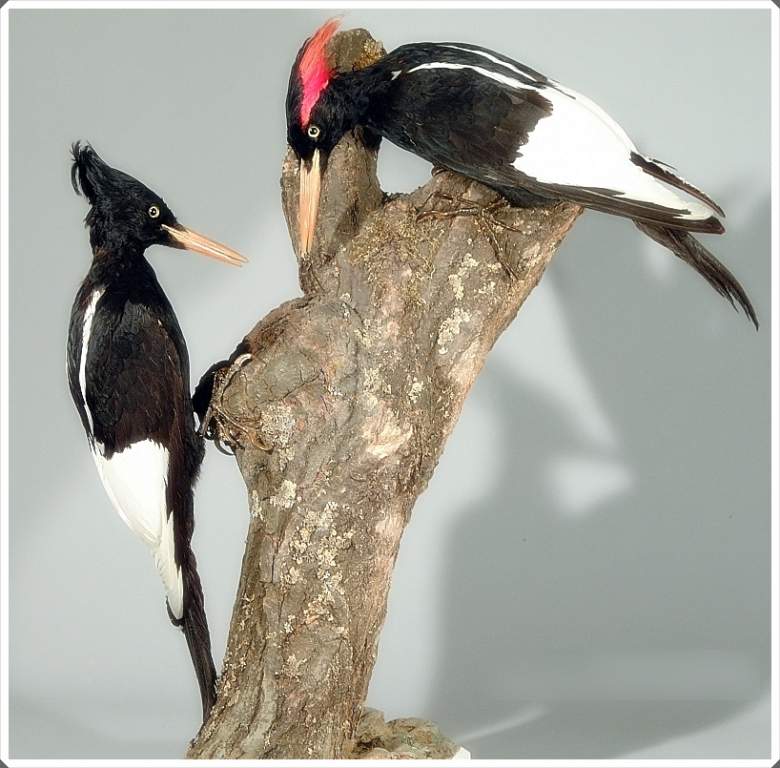
The Ivory-billed Woodpecker had a close relative that lived in the Sierra Madre Occidental of Mexico. Slightly bigger than the ivory-bill, this was the world’s largest woodpecker, and so it was called the Imperial Woodpecker. There were many similarities between the two species; curiously, Imperial Woodpeckers had adapted to high-altitude pine forests, whereas ivory-bills inhabited swampy bottomlands. Even though they lived in different environments, both were doomed to become extinct at around the same time.
The last confirmed ivory-bill sighting occurred in 1944, while the last believable sighting of an Imperial was made in 1956. A major difference between the two species’ history with humans lay in the photographic record. Unlike with the ivory-bill, it was always supposed that there were absolutely no photographs of the Imperial Woodpecker. Then, in 1997, more than 40 years after the species had vanished, it was revealed that, actually, there were pictures. But these were not just still photographs – this was film footage! And it had been taken during the last fully recognized sighting of the species in 1956.
As might be expected, the tale of the film’s discovery is a curious one. A Dutch ornithologist, Martjan Lammer Tink, had an intense interest in woodpeckers and was undertaking research at Cornell University’s Department of Ornithology. It was natural that he should select Cornell, as this was an institution that had supported James Tanner’s book on the ivory-bill, and it was also the place where many of Tanner’s research records were kept. As he went through this material, Lammer Tink came across a letter written to Tanner in 1962 from a dentist named William Rhein. In the letter, Rhein mentioned that he had shot some film in Mexico during 1956 and that it contained: Very poor footage of a female [Imperial Woodpecker] with several short flight shots taken hand-held from the back of a mule.
By the mid-1990s, Rhein was in his late 80s, and Lammer Tink had a good deal of difficulty in tracing him. He finally tracked him to his home in the intriguingly named town of Mechanicsburg, Pennsylvania. The two men were introduced and eventually sat down together to watch 85 seconds of film, shown from an old 16mm projector. Naturally, the quality is not good, but the film (today viewable on YouTube) clearly shows a female bird climbing a pine trunk, foraging, chipping off bark, and then flying away. Rhein promised to make a copy of the film, but Lammertink didn’t receive it until a couple of years later, after Mr. Rhein’s death.
The reason why he had never made the film available to the ornithological community before this time remains a mystery. Perhaps it’s poor quality embarrassed him; he just thought that no one would be interested. The species itself is almost as poorly known as the film was, although once it was not uncommon.
However, the almost destruction of the open pine forest environment in which it lived brought about its spiral into oblivion. There are certainly instances where hunting has been a major cause of extinction, but habitat destruction or alteration is the usual culprit. It is easy enough to point to exceptions, but as a general principle, hunting tends to affect individuals rather than whole populations. Whereas habitat loss means inevitable destruction for almost all the animals (and plants) that naturally occur in an area.
Only those able to rapidly adapt and take advantage of their new circumstances can survive. In this particular instance, logging and general land clearance robbed the woodpeckers of the homes and food supplies they needed, and although hunting by indigenous peoples may have accounted for many birds, the species was essentially doomed by the alteration of the landscape. In fact, those responsible for changing the environment actively encouraged the hunting of the birds.
They saw them as an inconvenience to their operations, and even promoted the application of poisons to the trees in which woodpeckers foraged – trees that were themselves doomed to ultimate destruction. A last As part of his ongoing search for any hint of evidence regarding the species’ survival, Martjan Lammertink decided to make some on-the-spot inquiries.
In 2010, along with his colleague Tim Gallagher (who has written a book, Imperial Dreams, on his exploits), he made a long, arduous and dangerous – due to political and criminal activity in the area – journey to the Mexican state of Durango, where the film footage was shot, and the place where the high-altitude pine forests used to grow. The two men collected several stories indicating that the Imperial woodpeckers survived long after the 1950s, but nothing tangible to suggest that they might still be there. As for the pines trees, they were long gone, and the grasses that once grew beneath them had been grazed away.
Also Read: Black-rumped Flameback Woodpecker Call