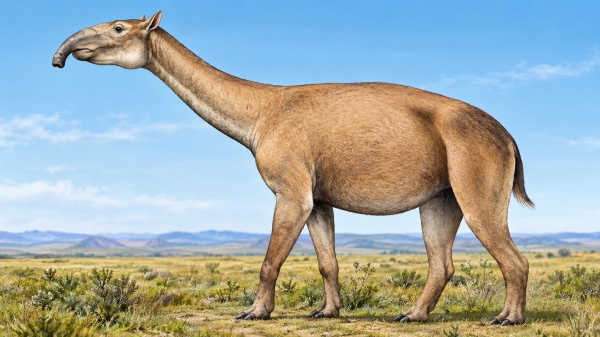
Scientific Name: Macrauchenia patachonia
Scientific Classification:
-
Phylum: Chordata
-
Class: Mammalia
-
Order: Litopterna
-
Family: Macraucheniidae
When did it become extinct?
This species of litoptern disappeared approximately 10,000 years ago.
Where did it live?
Litopterns were found exclusively in South America.
In 1834, during his explorations in Patagonia, the young Charles Darwin discovered the foot bones of an extinct herbivorous mammal. At first, scientists believed these bones had once supported a giant, llama-like animal. Later discoveries, however, revealed that they belonged to a very different creature. Most large plant-eating mammals that have inhabited the Earth over the past several thousand years can be divided into two major groups: odd-toed ungulates, or perissodactyls, which include horses and rhinoceroses, and even-toed ungulates, or artiodactyls, a group that includes deer, cattle, and many other familiar animals.
In the years following Darwin’s discovery, additional fossils gradually emerged, revealing that until roughly 10,000 years ago, South America had been home to its own distinctive collection of large herbivorous mammals. These unusual creatures were unlike the familiar odd-toed and even-toed ungulates found elsewhere in the world.
One group of these remarkable South American plant eaters was the litopterns. The last surviving members of this group resembled stocky, humpless camels with sturdy legs. Standing approximately 1.5 metres tall at the shoulder and measuring around 3 metres in body length, this litoptern was among the larger mammals of prehistoric South America. The animal’s nasal openings were positioned unusually high on its skull, leading paleontologists to suggest that it may have possessed a short trunk.
Although its precise function remains uncertain, this stubby appendage might have helped the animal grasp low-hanging branches and draw vegetation towards its mouth. This would have served a purpose similar to the way a giraffe uses its long, prehensile tongue to reach and pull vegetation from branches. The largest litopterns had broad, flat feet with three toes, while some of the more lightly built species possessed slender legs ending in a single toe. These limbs contained strong bones and flexible joints, characteristics associated with swift, agile animals capable of escaping danger through speed and manoeuvrability.
These unusual herbivores needed effective ways to avoid predators because prehistoric South America was inhabited by an impressive array of formidable carnivores. Fierce felines, predatory marsupials, and enormous flightless birds all posed serious threats. Litopterns therefore had to remain constantly alert, as any of these hunters could prove a dangerous adversary. Even a fully grown individual belonging to the largest litoptern species would have struggled against the most powerful sabre-toothed cat known to have lived, Smilodon populator (see the earlier entry, “Saber Tooth Cat”).
The soft underside of a litoptern’s long neck may have presented an especially vulnerable target for these formidable felines, making it plausible that litopterns were frequently hunted and killed by them. Larger terror birds, meanwhile, were probably capable of attacking smaller litoptern species as well as the young of larger ones.
Speed offered the smaller litopterns some protection, but their most effective defence may have been the safety provided by living in groups. Like many modern herbivorous mammals, these extinct animals probably travelled and fed in herds. For large animals surrounded by numerous predators, group living offers an important advantage: several individuals can keep watch for approaching danger at the same time. Most predators depend heavily on surprise to capture their prey, and once that advantage is lost, a successful hunt becomes much more difficult. Litopterns likely relied on their keen eyesight, strong sense of smell, and acute hearing to detect threats and alert the rest of the herd. When predators attacked, they probably concentrated on young, old, or sick individuals, as a healthy adult litoptern would have been a challenging animal to catch.
With so many predators eager to sink their teeth, claws, and beaks into their flesh, life on the grasslands of prehistoric South America must have been demanding for litopterns. Around 2.5 million years ago, another major development made their survival even more difficult. The Great American Interchange brought numerous animal species from North America into South America. Some competed with litopterns for available food, while others hunted them directly. These newcomers arrived during a period of broader environmental change. Sea levels were falling, and the global climate was becoming cooler and drier, conditions that threatened trees, which may have been among the litopterns’ preferred food sources.
The period following the Great American Interchange must have presented these unusual ungulates with considerable challenges. Their habitats were shrinking, unfamiliar animals from the north were competing for dwindling food supplies, and several species of cats that had migrated south were well equipped to hunt them with their powerful teeth and claws. Much later, humans spread throughout South America and may also have hunted the remaining litoptern populations, which by then had probably declined considerably from their former numbers. Pressured by habitat loss, competition, and predation, these distinctive plant-eating mammals eventually vanished around 10,000 years ago.
Interesting Facts About Litopterns
– Charles Darwin’s fossil discovery: Darwin discovered and excavated the bones of several extinct South American mammals during his voyage aboard HMS Beagle. The ship spent time in Patagonia, giving him an opportunity to explore the region and investigate its remarkable fossil remains.
– Meaning of the name: The word “litoptern” means “simple ankle.” It refers to the structure of the animals’ ankle bones, whose arrangement was less complex than that found in other large herbivorous mammals.
– A widespread species: Fossils of Macrauchenia patachonia have been discovered across a broad area, extending from Patagonia northwards to Bolivia. Many litoptern fossils have also been recovered from the Luján Formation near Buenos Aires, Argentina.
– Predators from the north: Placental mammalian predators that entered South America during the Great American Interchange included familiar modern animals such as jaguars and pumas. Their arrival added to the challenges faced by the continent’s native wildlife. Read More: Northern Flying Squirrel