Name: Eskimo Curlew
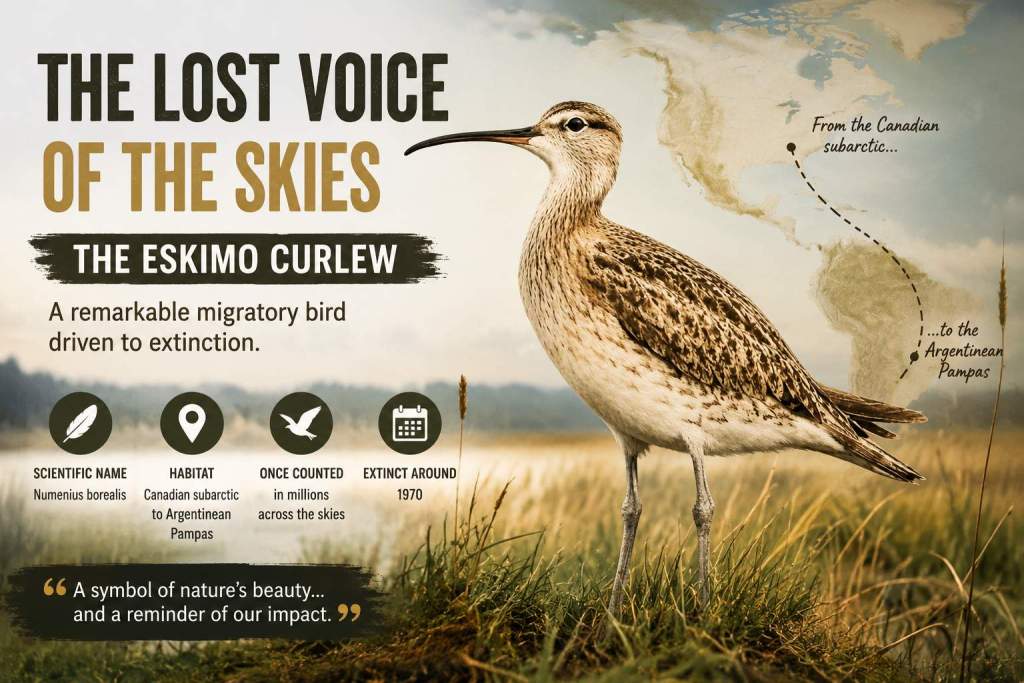
Scientific name: Numenius borealis
Scientific Classification
- Phylum: Chordata
- Class: Aves
- Order: Charadriiformes
- Family: Scolopacidae
When did it become extinct?
The Eskimo curlew is thought to have become extinct around 1970.
Where did it live?
During the northern summer, the Eskimo curlew inhabited the Canadian subarctic. Its wintering grounds were on the Argentinean Pampas, south of Buenos Aires.
The story of the Eskimo curlew is a tragic tale of greed, senseless waste, and a powerful example of how destructive human activity can be. This small wading bird grew to no more than 30 cm in length and possessed an elegant bill about 5 cm long. Like other curlew species, it had a distinctive and beautiful call. The Inuit name for the bird, pi-pi-pi-uk, was an imitation of the sound it made both in flight and on the ground.
The Eskimo curlew may have been a small bird, but it was one of the most remarkable long-distance travelers ever to grace the skies. Like many other wading birds, it divided its life between northern breeding grounds and southern wintering areas. The journey between these distant regions was no simple undertaking. These small birds faced one of the most demanding and hazardous migrations in the animal kingdom.
As the brief northern summer drew to a close and the young birds had been raised, the curlews took flight to begin an arduous journey. Their migration followed an immense clockwise route. Starting on the Canadian subarctic tundra, the birds traveled through the Western Hemisphere, moving eastward through Labrador, down across the Atlantic, and over the southern Caribbean. They continued this epic passage until they reached their wintering grounds on the Argentinean Pampas. Some migrating birds traveled even farther, eventually reaching Chile.
The birds remained in South America for several months. When spring returned to the north, the pull of hundreds of thousands of years of inherited migratory behavior sent them skyward once again. They began the return journey toward their breeding grounds, passing through Texas, Kansas, Missouri, Iowa, and Nebraska.
Completing such a demanding migration nonstop was impossible, so the enormous flocks regularly stopped to rest and replenish their energy. The prairies of the American Midwest were among their favored refueling sites. There, the curlews used their long bills to probe the soil for insect eggs, larvae, and pupae. Interestingly, these important feeding stops are thought to have been closely linked to the presence of the Rocky Mountain locust, another extinct species that once occurred in astonishingly large swarms.
The dangers of the journey were numerous and severe. The North Atlantic is frequently battered by powerful storms, and every year some curlews were blown far from their route, leaving them isolated and hungry in the cold expanse of the ocean. Some stragglers even reached Britain or landed on the decks of Atlantic ships.
It appears that the entire global population of Eskimo curlews traveled together in one enormous flock, which at its height probably contained millions of birds. There is safety in numbers, yet countless individuals must still have fallen victim to predators or died from exhaustion each year. These natural hazards became dramatically worse after Europeans began settling across North America.
Because the curlews gathered in enormous flocks, settlers nicknamed them “prairie pigeons,” recalling the vast gatherings of passenger pigeons that once darkened the skies of eastern North America. One account from 1860 described an Eskimo curlew flock measuring more than 1 km in length and width.
Any animal that is edible and appears in enormous numbers is likely to attract hunters, and unfortunately, the curlew possessed both characteristics. Although the birds appeared to be plentiful, the massive flocks targeted by hunters represented the species’ entire worldwide population. Relentless hunting therefore began to take a devastating toll.
During their feeding stops on the long journey north, hunters would approach the flocks. When the birds sensed danger, they would suddenly rise into the air. This was an effective defense against predators on the ground and birds of prey, but it offered little protection from shotguns. Because the curlews were packed so closely together as they lifted from the ground, a single shotgun blast could kill 15 to 20 birds.
The slaughter became so extreme that countless dead birds were simply abandoned to rot in enormous piles. Others were collected and hauled away in great numbers on horse-drawn carts. This wasteful destruction during the birds’ northward migration was already devastating, but before long, hunters also began targeting the curlews on their breeding grounds.
During the northern summer, the birds prepared for their long migration south by feeding heavily on the swarms of insects that appeared across the tundra during its brief period of warmth. As a result, they became exceptionally fat. Hunters referred to these well-fed birds as “doughbirds,” but even this temporary abundance did not protect them.
Hunters located their nighttime roosts and slaughtered the birds under the cover of darkness, using lanterns to dazzle them before clubbing them with sticks. Those fattened birds that survived eventually took to the air and began their migration. However, powerful gales often pushed them toward New England, where their arrival became a signal for people with guns to hunt them.
During the 1830s and 1840s, storms blew some of the birds off course and carried them to Nantucket. The local population killed the curlews with such intensity that the island eventually ran out of gunpowder and shot, temporarily bringing the slaughter to a halt.
Under such relentless hunting pressure, the Eskimo curlew was heading toward extinction. In 1900, Paul Hoagland was hunting with his father near Clarks, Nebraska. They startled 70 Eskimo curlews into flight and followed them to a recently plowed field. With four shots, they killed 34 of the birds.
In 1911, the same man encountered eight Eskimo curlews and killed seven of them. Once part of enormous flocks covering an area equivalent to around 38 football fields, these few remaining birds represented a heartbreaking decline. The group seen in Nebraska was the last known collection of Eskimo curlews recorded there.
Since 1900, ornithologists collected 20 Eskimo curlews. In 1964, the last confirmed individual of the species was shot in Barbados. Lonely birds may have continued to follow their ancient migration routes, but the Eskimo curlew has likely disappeared for good.
- Hunting undoubtedly had an enormous impact on the Eskimo curlew, but agriculture is also believed to have contributed to its decline. Much of the fertile prairie that served as an important refueling area was converted to farmland, while many of the insects on which the birds depended declined in abundance. One notable example was the Rocky Mountain locust, which once occurred in swarms of extraordinary size.
- Birds that live and migrate in large flocks rely on the strength of numbers for protection. A solitary curlew would have had little chance of avoiding predators during its demanding migratory journey. If any Eskimo curlews still survive, their existence would remain uncertain and filled with danger.
-
 Eskimo Curlew: The Lost Migratory Bird That Once Filled the Skies
Read More: Yellow-throated Honeyeater (Nesoptilotis flavicollis)