Passenger Pigeon—No Longer with Us
Once the most numerous bird on the planet, the graceful passenger pigeon was a very fast flyer.
When did it become extinct? The last known passenger pigeon died on September 1, 1914, in the Cincinnati Zoo.
Where did it live? The passenger pigeon was a native of North America, but during their winter migrations, the birds headed south, with some reaching as far as Mexico and Cuba.
In the late nineteenth century, anybody who suggested that the passenger pigeon was in danger of imminent extinction would have been branded a fool. The passenger pigeon existed in such colossal numbers that it is astonishing that it is no longer with us. The species was so numerous that there are many accounts of the bird itself and the enormous flocks in which it collected. Estimates for the total number of passenger pigeons in North America go as high as 9 billion individuals. If these estimates are anywhere near the true number, then the passenger pigeon was undoubtedly one of the most numerous bird species that has ever lived.
This enormous population was not evenly spread, but was concentrated in gigantic flocks so large that observers could not see the end of them and so dense that they blocked out the sun. Some records report flocks more than 1.6 km wide and 500 km long—a fluttering expanse of hundreds of millions of passenger pigeons. We can only imagine what one of these flocks looked like, but we can be sure that it was quite a spectacle.
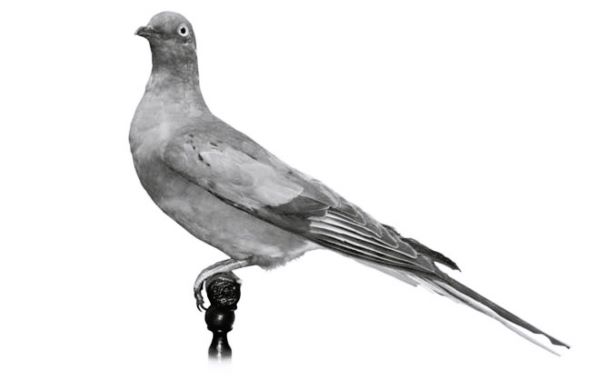
Apart from its propensity for forming huge flocks, the passenger pigeon was quite similar in appearance to a domestic pigeon, although it was considerably more graceful, with a slender body and long tail. Most pigeons are built for speed, but the passenger pigeon was a real racer. Its tapering wings, powerful breast muscles, and slender body gave it a real turn of speed.
There is anecdotal evidence that these birds could reach speeds of 160 km per hour, although they usually flew at 100 km per hour. The aerial abilities of the passenger pigeon came in very handy as it was a migratory species. As the summer arrived in the northern latitudes, the birds would leave their wintering grounds in southern North America and head for the lush forests of the United States and Canada, although their aggregations appeared to be particularly dense on the eastern seaboard.
They came to these immense forests (only remnants of which remain today) to raise young on a diet of tree seeds (mast), forming huge nesting colonies in the tall trees. As with most pigeons, the nest of the passenger pigeon was a rudimentary affair of twigs that served as a platform for a single egg. The parent birds nourished their hatchling on crop milk, the cheese-like substance secreted from the animals’ crops that is unique to pigeons.
This cycle of migration had probably been going on for hundreds of thousands, if not millions, of years, but all was about to come to an end as Europeans first arrived in the Americas. Their arrival signalled the end for the passenger pigeon, and many more species besides. Europeans, in their attempts to settle these new lands, brought with them new ways and means of growing food. The forests were hacked down to make way for these crops, and the passenger pigeons were quick to exploit this new source of food.
Settlers first killed the passenger pigeons to protect their crops, but they soon realized that these birds were a massive source of nutritious food, and the slaughter began in earnest. The adult birds were normally preyed on when they were nesting. Trappers equipped with nets constructed smoky fires beneath the nesting trees to force the adults into taking flight.
Trees with lots of nests were cut down, enabling trappers to get their hands on the young pigeons. The slaughter was senseless and wasteful, with often only the feathers of the birds being taken to be used as stuffing. Of course, the birds were valued as cheap food, and millions of birds were taken by train to the big cities on the East Coast of the United States. It has been said that during the end of the eighteenth century and for much of the nineteenth century, servants and slaves in these big cities may have eaten precious little animal protein apart from passenger pigeon meat.
For several decades, passenger pigeons ready for the oven could be bought for as little as three pennies. By 1896, only 250,000 passenger pigeons remained, grouped in a single flock, and in the spring of that year, a group of well-organized hunters set out to find them. Find them they did, and they killed all but 5,000 of them. Only three years later, the last birds in the wild were shot. Once the most numerous birds on the whole planet, the passenger pigeon had been wiped out in a little more than 100 years.
- It is thought that the passenger pigeon’s breeding and nesting success were dependent on there being huge numbers of individuals. Habitat destruction and hunting led to the collapse of the populations past this threshold. With their flocks in tatters and continual nesting disruption, it was not long before the population fell below recoverable levels. Scientists have also suggested that the dwindling populations of passenger pigeons could have been forced over the edge by an introduced viral infection known as Newcastle disease.
- The nesting colonies of passenger pigeons were huge, covering an area of up to 2,200 km 2, which is considerably bigger than the area of Jacksonville in Florida.
- Passenger pigeons were used to feed pigs and were processed to make oil and fertilizer. Although the adult birds were eaten in their millions, the young pigeons, known as squabs, were said to be delicious.
- The term stool pigeon originates from the practice used by hunters to kill large numbers of passenger pigeons. A single bird was captured, and its eyes were sewn shut with thread before it was attached to a circular stool that could be held aloft on the end of a stick. The stool would be dropped, and the pigeon would flutter its wings as it attempted to land. Other pigeons flying overhead would see one of their number apparently alighting, and they, too, would land in the hope of finding food, allowing the hunters to snare them with nets.
- Large numbers of skins and preserved specimens of passenger pigeons found their way into private collections, with at least 1,500 preserved specimens held around the world.
- It has been suggested that before Europeans arrived and settled in North America, the populations of the passenger pigeon were held in check by Amerindian hunting. As the tribes of these people dwindled, so did their influence on the animals and plants of the eastern United States, and populations of animals like the passenger pigeon experienced explosive growth.
- The hunting of the passenger pigeon was so intense that in 1878, a single hunter shipped more than 3 million birds to the big cities of the eastern United States. Nets and traps caught vast numbers of birds, and a variety of shotguns were used by professional hunters, marksmen, and trapshooters.
Scientific name: Ectopistes migratorius
Phylum: Chordata
Class: Aves
Order: Columbiformes
Family: Columbidae
Read More: Feral Pigeon – Exploring the Facts and Woes of Urban Nomads