Explore the complex legacy of Wernher von Braun, the mastermind behind the V2 rocket and NASA’s Apollo missions, whose memorable legacy bridges war weapons and space travel.
In the Second World War, rockets came into their own as a means of sending explosive warheads over long distances. This is the origin of the ballistic missile, although the term only became current in the 1950s. The most successful rocket, the V2, first used in August 1944, was German. In the years following the war, its inventor, Wernher von Braun (1912-77), would become the dominant figure in rocket technology, not only for missiles, but also for space travel.
The political history of the rocket in the twentieth century is at least as remarkable as its scientific development. Following the First World War, scientists in Germany, Russia, and the United States already saw the rocket as a means for going beyond the earth’s atmosphere into space. In Germany, the leading figure was Hermann Böhringer (1894-1989), and he, together with others sharing his enthusiasm for rockets, organised the Vereinfiir Raumschiffahrt, the ‘society for space travel’.
In 1928, Wernher von Braun became a member while still at school. He was a prodigy born into a wealthy, cultured, intellectual, aristocratic family: his father, a minister in the government that Hitler drove out of office in 1933, was intolerant of any form of corruption. Out of office, he survived the twelve years that Hitler was in power by successfully maintaining a low profile. This was hardly true of his son. The younger von Braun, having enrolled in the Technische Hochschule in Berlin (where he saw his first rocket motor), soon realised that only the German military had the means to develop rockets, which also had the advantage of not being subject to the armament limitations imposed by the Treaty of Versailles in 1919. Von Braun’s first employment, at the Raketenflugplatz, or ‘rocket airfield’, Reinickendorf, was soon noticed by the military, and he was offered a senior position in development and research.
The year 1934 saw von Braun, twenty-two years old, gain his Ph.D. for a thesis entitled ‘Combustion Phenomena in Liquid Propellant Rocket Engines’. This came from the Friedrich -Wilhelm University in Berlin, where von Braun had lectures from three Nobel prize winners, Erwin Schrödinger, Max von Laue, and Walter Nernst – giving him a useful connection with the scientific establishment. In the same year, the rocket on which he had been working had its first successful altitude test. Beginning in 1935, a new site, located near a remote fishing village, Peenemunde, on the Baltic Sea, was acquired for the military programme, and von Braun became its scientific director.
This was to be the most successful of all the German weapons programmes in the Second World War. Von Braun’s skill as an engineer and his understanding of the problems of rocket performance were focused on a single weapon, the A4 rocket. This had its first successful launch on 3 October 1942, when it reached a height of 85 kilometres over a range of 190 kilometres. Although Hitler, following a revelation in one of his ‘infallible ‘dreams, had predicted failure, full production was ordered. Then, on 17 August 1943, the RAF bombed Peenemunde, causing such damage that Hitler immediately ordered production to be transferred to an underground site, at the same time entrusting it to Heinrich Himmler’s secret police. A disused mine in the Harz Mountains (far from Peenemünde) was converted into an underground factory, to be known as Mittelwerk, running on slave labour.
Von Braun, remaining in Peenemunde, soon made clear that his operation was not part of Himmler’s empire. In March 1944, this led to his arrest on the charge that he never intended the A4 as a war weapon, but only for space travel – an incident that would soon become a useful part of his curriculum vitae (even though he was released within two weeks).Mittelwerk in all produced nearly 6000 rockets, 14 of which 3200 were launched operationally. The first cities to be targeted, on 8 September 1944, were Paris and London. Then, in January 1945, with Peenemunde facing the advancing Soviet armies, von Braun was ordered to evacuate his entire operation to Bleicherode in central Germany. The first train left a month later, and then in April came a final move to Oberammergau.
With the end of the war fast approaching, von Braun found a safehouse in the nearby village of Oberjoch. When the Americans arrived, he sent his younger brother, Magnus, who spoke near-perfect English, to make contact and explain what he had to offer to the West. Von Braun, summoned for interrogation, was able to retrieve technical documents from Peenemunde, which he had hidden in a mineshaft. An American expert, after examining them, reported that ‘one of the greatest scientific and technical treasures in history is now securely in American hands’. Von Braun also told the Americans how to locate some 1000 people who had worked at Peenemünde but had escaped to the West.
He also pointed out that the Mittelwerk production line would be part of the Soviet Zone of Germany. The Americans, in nine days, took away 341 freight cars containing parts and machinery, and shipped the whole lot to the United States. Von Braun was also beginning to sell the idea that he and his team should go as well. By this time, with the Pacific war coming to its end after the first operational use of atomic bombs, the Americans did not doubt that they wanted von Braun. In the end, he moved to the United States with 126 of his colleagues from Peenemünde. The 127 Germans were first set to work in Fort Bliss, Texas, where they remained, officially, prisoners of war.
Then in 1950, they became recognised immigrants, and in 1955, after a further and final move to Huntsville, Alabama, they all became American citizens in one grand ceremony. The operation at Huntsville was organised into thirteen divisions, and as late as 1962, all of them were still headed by one of the original Germans (the last of whom would only retire in the 1990s); it was only in 1973, with a new director, that the Germans ceased to dominate at Huntsville. On 10 October 1957, the Soviet Union launched Sputnik, the first successful satellite, and on 12 April 1961, Yuri Gagarin became the first man in space. These Soviet achievements were a considerable spur to work at Huntsville, and within months the Americans had drawn level.
Then, in the course of the 1960s, with the Apollo Moon Project, led by Von Braun, the United States drew ahead to achieve the first successful moon landing on 16 July 1969. By this time, the usefulness of rockets to science was beyond doubt. Even so, what was their essential contribution? The answer lies mainly in the character of the Earth’s atmosphere. For one thing, as Fred Whipple, professor of astronomy at Harvard, noted, the optical system of an earthbound telescope is ‘like a dirty basement window’. Something can be done by building observatories at the top of mountains, in a relatively dry and dust-free location, such as Mauna Kea in Hawaii, where a whole cluster occupies the summit. But going into space, as with the Hubble telescope, provides a spotlessly clean window.
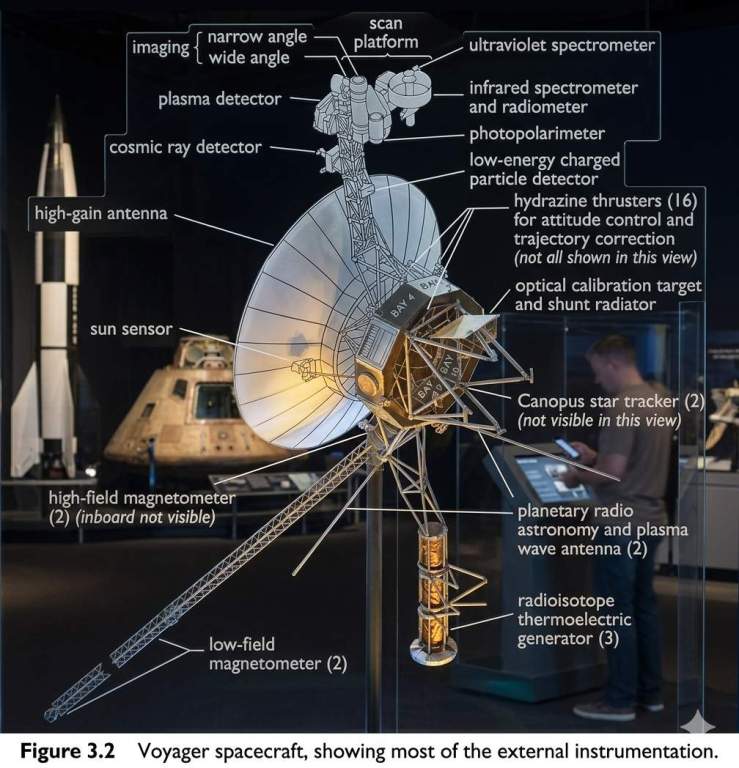
Besides a telescope, many other kinds of instrumentation can be part of the payload of a rocket-powered vehicle in space, so that measurements can be taken of cosmic and X-rays, the frequency of light from the sun, to say nothing of the temperature, pressure, and composition of the atmosphere at high altitudes. To give one specific example, the measurements taken by Geiger counters on the Explorer I satellite,19 launched on 31 January 1958, led to the discovery of the Van Allen radiation belts, now essential to atmospheric studies. There was only a beginning: the further spaceships such as the Voyager can reach, the greater becomes the wealth of information, particularly about other planets. These discoveries were not von Braun’s: he merely provided the technology. As Fred Whipple said, ‘Wernher was an engineer, not a scientist, in the eyes of scientists.’ The technology had many dimensions, and von Braun was a master of all of them.
His particular strength lay in the use of liquid fuels (as shown in his 1934 Ph.D. Thesis). In addition, he was the first to develop booster and multistage rockets – so that, for example, the Saturn launched the first moon rocket, while the Apollo carried it on to the moon. The choice of materials, both for the rocket shells and everything inside, was always critical; electronic systems had to be devised, with increasing dependence on computers; communications with the NASA Johnson Space Center at Houston, Texas, had to be assured. Few men in the last fifty years have attracted so much praise as von Braun. A good-looking man, blond and heavy-set, he looked people straight in the face to capture them with his charm and charisma. He enjoyed sailing, flying, scuba-diving, but also played the piano (having had, as a boy, lessons from the composer Paul Hindemith) and the cello.
He was variously described as a scientist, engineer, philosopher, humanitarian, politician, diplomat, realist, and visionary – all in all, too good to be true. His professional knowledge was essentially second-hand and derivative, but he coordinated and managed brilliantly, and people always saw that he was a winner. Throughout his life, he made his own luck, and others paid the price. While he was at Peenemunde, the rockets he designed were being made by slave labour, by people working under appalling conditions, at Metalwork. Once these rockets were operational, they killed several thousand people: during the Second World War, they were the most successful new weapon at the disposal of Hitler.
It is not for nothing that vonBraun’s A4 rocket, once operational, was renamed V2 – with the V for Vergeltungszwaffen, a weapon of retribution, which was precisely its appeal to the Nazi leaders. The same easy conscience that allowed von Braun to prosper under Hitler stayed with him in the United States, where his rockets could carry an unprecedentedly destructive payload. They were never used to deliver the payload (just as the V2 did not save Germany in the war).
However, still, von Braun’s legacy is not all gain, despite the long familiar list of rocket-powered vehicles in space -Apollo, Mariner, Mercury, Galileo, Magellan, shuttle, Skylab, Viking, Neptune, Voyager – all evoke the memory of one man. Even so, as Carl Sagan once said of von Braun: ‘He was willing to use nearly any argument and accept any sponsorship as long as it could get us into space. I think he went too far… The modern rocket, which he pioneered, will prove to be either the means of mass annihilation through a global thermonuclear war or the means that will carry us to the planets and the stars.
This dread ambiguity, which faces us today, is central to the life of Wernher von Braun. ‘And then, going back to the 1960s, Tom Lehrer reminds us how When the rockets go up, who cares where they come down That’s not my department, says Wernher von Braun.
Read More: How Hydrocarbon Fuel-Engined Revolutionized 20th Century Transport