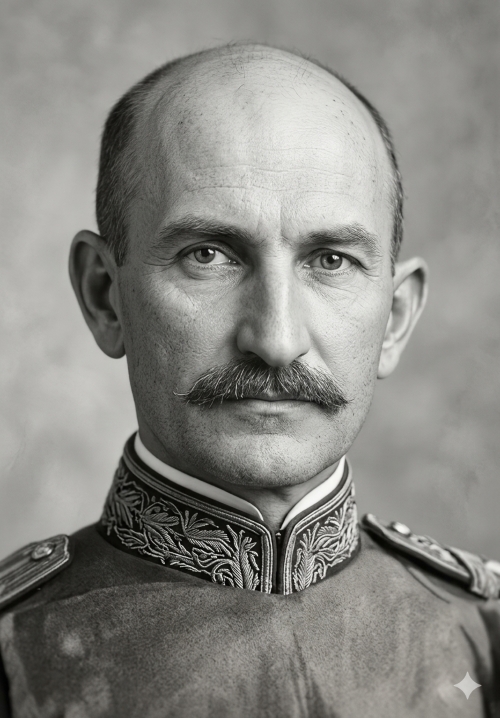
The incredible untold life of Frank Canton, the feared lawman and hired gun tied to the Johnson County War.
“Death Claims General Frank Canton, Noted Peace Officer and Former Adjutant General.”
An eye-catching headline indeed.
The American West produced many generals and countless peace officers, yet few men combined both roles as distinctly as Frank Canton. The article announcing Canton’s death appeared on Thursday, September 29, 1927, in his hometown newspaper in Edmond, Oklahoma. He had passed away at the age of seventy-eight after a remarkably active and controversial life.
Despite the publication of his autobiography in 1930 by a major publishing house, Canton has remained relatively obscure. In many ways, however, he was a more professional lawman than celebrated frontier figures such as Hickok, Earp, Garrett, or Masterson. It is surprising that Hollywood never fully embraced his story. What separated Canton from many of his contemporaries was a darker reputation: he was widely regarded as a hired killer. Even more remarkable was the fact that he spent most of his life living under an assumed name—largely because it was safer that way.
In 1878, Frank Canton fled Texas just ahead of the Rangers. He surfaced in Ogallala, Nebraska, driving a trail herd before eventually making his way to Miles City, Montana. There, he accepted employment with the Wyoming Stock Growers Association as a range detective. Canton and the Association would remain closely connected for thirteen turbulent and bloody years before separating in the aftermath of a violent range war.
Canton also carried another claim to fame. When author Owen Wister died, Canton’s widow told reporters:
“My husband spent much time with Mr. Wister, giving him the framework on which The Virginian was based. The writer always said he drew the central character around my husband.”
Interestingly, Frank Canton himself had been born near Richmond, Virginia, in 1849. Elsewhere, however, Wister insisted that the Virginian was entirely a creation of his imagination.
While employed by the Wyoming Stock Growers Association, Canton relocated to Buffalo in Johnson County, Wyoming, in 1880. It was there that his career as a professional lawman truly began. Shortly after arriving, he also entered the ranching business. Within two years, he was elected sheriff and served two consecutive terms from 1882 to 1886.
His jurisdiction covered nearly 12,000 square miles of mostly unsettled prairie, rugged badlands, and isolated mountain country. The nearest railroad lay 250 miles south at Rock Creek, Wyoming. At the time, Wyoming lacked a penitentiary, so when Canton arrested prisoners, he escorted them by train all the way to Joliet, Illinois, where Wyoming leased prison services.
One of Canton’s earliest arrests involved Teton Jackson, a notorious outlaw from Bitter Creek—a murderer and horse thief. Canton dryly remarked:
“He was a Mormon and a member of a gang of Mormon outlaws whom they called the Destroying Angels.”
Acting on a tip, Canton and two deputies, Chris Gross and Ed Lloyd, rode forty dangerous miles through mountain trails during the night to reach the remote cabin of a hunter named Lucas, where Jackson was believed to be hiding. At dawn, Canton entered the cabin alone and held both occupants—Jackson and Lucas—at gunpoint. Recognizing Jackson from his description, Canton secured the arrest and sent Lucas and the deputies to gather the stolen horses grazing nearby.
Left alone with Jackson, Frank Canton soon encountered trouble. Jackson complained that the handcuffs were too tight. Though still keeping him covered with a revolver, Canton tossed him the keys. Later, Canton described the outlaw vividly:
“He was not a pleasant companion. I have never seen a man of his description before or since. He was about forty-five, over six feet tall, weighed a hundred and ninety pounds, with a stubby beard, coarse features, flaming red hair, a red face, and eyes as black as a snake’s.”
What followed reveals much about Canton’s personality and methods. The moment the cuffs came off, Jackson became abusive and threatening. Canton later wrote:
“…he wanted to serve notice on me right there and then that he was a better man than I was, even without a six-shooter.”
Frank Canton stared him down and calmly replied that he would rather bring him in dead because it would involve far less trouble and earn the same reward. He then tossed the handcuffs back to Jackson and gave him ten seconds to put them on again.
Frank Canton later commented with characteristic understatement:
“I think he put them on in less time than I had given him. We landed him in jail in Buffalo that night.”
Frank Canton also helped make stage robbery unpopular along the dangerous 450-mile stretch between Rock Creek, Wyoming, and Custer Station, Montana. The lonely route had long attracted road agents eager to rob Wells Fargo shipments. He eventually captured a notorious highwayman named Bill Brown and his accomplice near Pinney Creek, north of Buffalo. Both men received life sentences, and stage robbery rapidly declined in the region afterward.
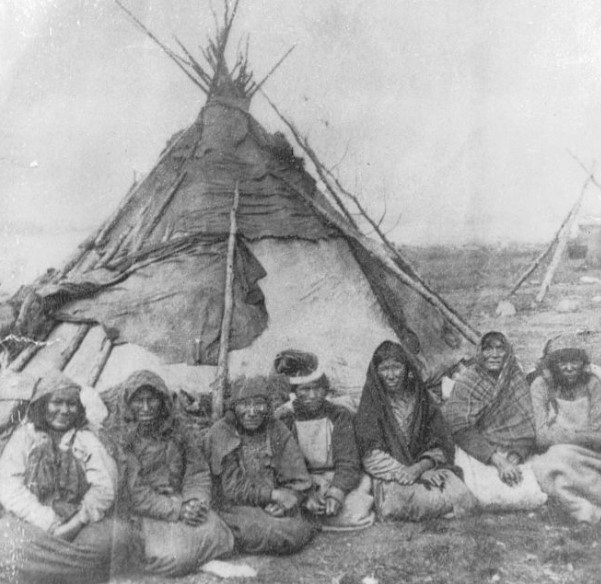
During his second term as sheriff, Canton faced a memorable confrontation with a renegade faction of the Arapaho tribe led by Chief Sharp Nose. After the cowboys interrupted two Indians butchering a stolen steer, a hat left behind pointed suspicion toward a warrior named Samuel, who belonged to Sharp Nose’s band.
Displaying remarkable nerve, Canton entered Sharp Nose’s teepee, seized Samuel directly from his bed, and hurried him back to Fort Washakie before the tribe could react. Yet the greater challenge still remained: transporting the prisoner safely to Buffalo. Most of the cavalry had already departed for Arizona in pursuit of Geronimo, leaving Canton largely on his own.
Sharp Nose and his warriors silently shadowed Canton and his deputies along the trail. At one point, the chief himself attempted to block their path and was nearly ridden down by Canton’s horse. Eventually, the Indians withdrew. Canton had gambled correctly that Sharp Nose was bluffing—a risk requiring extraordinary courage.
Frank Canton chose not to seek reelection for the 1886–1888 term, though he soon regretted the decision. Instead, he accepted a position as chief range detective for Johnson County under the Stock Association, earning the substantial salary of $200 per month. Unfortunately, the devastating winter of 1886–1887 crippled the cattle industry. Herd losses averaged 50 percent and, in some cases, reached as high as 90 percent. Canton’s salary was reduced, and eventually he was dismissed altogether.
At the same time, a larger conflict was unfolding across the cattle frontier. Wealthy cattle interests increasingly consolidated power, creating tensions that resembled a class war. One particularly shortsighted decision by large ranching operators was ending the long-standing practice of allowing unemployed cowboys to “ride the grub line” until they found work. Though modest, the practice had functioned as a form of frontier charity. With jobs disappearing and little support available, many desperate cowboys turned to rustling livestock from the same ranchers who had refused to feed them.
The major stockmen used this growing wave of theft as justification to label nearly all small ranchers as rustlers and drive them off the range. Frank Canton largely glossed over these realities in his autobiography, which is understandable given that he worked for the powerful cattle interests. The clearest example of this escalating hostility became the Johnson County War—a conflict in which Canton played a central role.
Among the small operators who challenged the Stock Association were Jack Flagg, Nate Champion and his brother Dudley, Al Allison, John A. Tisdale, Ranger Jones, and, earlier still, Jim Averell and Ella Watson, better known as “Cattle Kate.” Averell and Watson were lynched in Sweetwater in 1889 by six influential cattlemen who opposed their homestead. The four witnesses connected to the lynching either disappeared or died suspiciously young, foreshadowing the increasingly ruthless methods of the cattle barons.
Several of the others met violent ends as well. Nate Champion, Tisdale, and Ranger Jones were all eventually killed by cattlemen. Canton himself was accused of personally murdering Tisdale and Jones. Evidence strongly suggests he at least killed Tisdale. He was also implicated in an earlier attempt, alongside two companions, to assassinate Nate Champion while the latter supposedly slept inside his cabin.
On the morning of December 1, 1891, someone ambushed John A. Tisdale several miles south of Buffalo. He had been returning home with a wagon filled with winter provisions and Christmas gifts for his children. Witnesses later testified that Tisdale had already received warnings that someone intended to kill him.
By chance, Charlie Basch—a close associate of Canton at the time—came upon the murder scene and spotted Canton standing less than one hundred feet away. According to Basch, Canton drew his revolver before apparently recognizing him and slowly returning the weapon to its holster. Terrified, Basch rode on without acknowledging him.
Farther up the road, Basch encountered Elmer Freeman and recounted the entire incident. Yet by the time of the coroner’s hearing, he had clearly reconsidered the danger of speaking openly. Instead of directly accusing Canton, Basch merely stated that he recognized the horse. Rumors later circulated about a mysterious sealed package, supposedly to be opened only after Basch’s death, which people believed contained the full truth about the killing. Apparently, no such revelation ever emerged.
Basch likely survived only because years earlier he had prevented a runaway buggy accident that probably saved one of Canton’s children and had later made a desperate horseback ride to fetch a doctor after Canton’s wife was injured in the crash. by Glenn G. Boyer
Read More: Oliver Cromwell – A Revolutionary Leader who Shaped Modern England